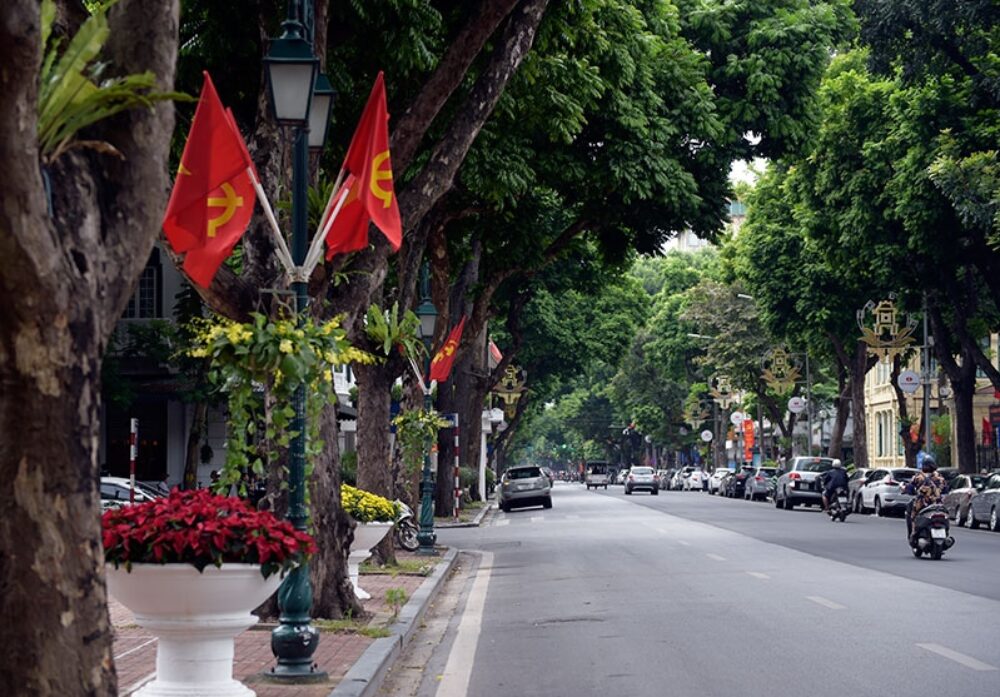

Tên lửa này Made in Russia, bắn hết là hết
There was a time when the Chinese military was famous for its kung fu-style training: breaking bricks and roof tiles, pressing spear tips against their throats, abdomens, or chests, and practicing meditation to cultivate “internal energy” (*neigong*).
They released videos showcasing “iron-bodied” Chinese soldiers—smashing stacks of bricks and tiles with their bare hands; having stones placed on their heads and shattered with hammers, leaving their heads unharmed; taking blows from clubs on their bare skin until the clubs broke, while their bodies remained unscathed; pressing spear tips against their throats or navels; and pushing vehicles—all without sustaining injury.
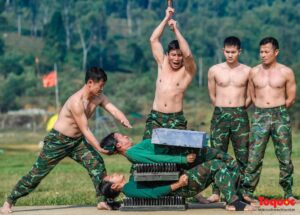
Võ chặt gạch chém ngói này không bảo vệ được biển đảo
However, 15 years ago, the Chinese military abandoned this “brick-breaking, tile-smashing, internal energy” training. They shifted toward a professional, modern approach for their military and police forces—emphasizing proficiency with weaponry, the operation of drones and UAVs, the use of man-portable missiles and tablet-controlled missile systems, and the adoption of Mixed Martial Arts (MMA) rather than traditional styles like Kung Fu, Shaolin, Wodang, or Ngamei.
Why was this change made?
The reason is that a modern, professional military requires soldiers to be highly proficient with weapons and marksmanship. They must be skilled in operating drones and man-portable missile systems—often controlled via tablets—as well as executing coordinated joint operations. Furthermore, they need to be digitally literate, possess a command of English, and maintain a robust, physically fit body. This entails meeting specific fitness standards, such as performing 10 push-ups, 10 squats, 10 pull-ups, a 50-kilogram bench press, and running several kilometers daily.
As for practices like breaking bricks or roof tiles and cultivating “internal energy” (*nei gong*), there is no scientific or practical evidence to suggest these methods are effective for improving health, physical fitness, or combat capability in the defense of one’s nation.
Recently, numerous videos have surfaced on YouTube featuring bouts between practitioners of Chinese Kung Fu or Shaolin arts and fighters from disciplines such as Muay Thai, Kickboxing, MMA, and Western-style boxing. In these contests, the Kung Fu and Shaolin practitioners have frequently suffered resounding defeats—not necessarily due to a lack of personal ability, but because the training methodologies inherent to these traditional arts are fundamentally flawed.
In Vietnam, a similar situation exists: special forces personnel and mobile police units are often seen training in—and performing—feats such as breaking bricks and tiles, cultivating “internal energy,” pressing spears against their abdomens, or having hammers struck against stones balanced on their heads or arms.
Such training and performance methods cause severe, destructive trauma to the human body, while offering absolutely no benefit to one’s health, physical fitness, or combat effectiveness.
Ultimately, these practices serve no purpose other than to provide a visually striking spectacle during peacetime. In an actual combat scenario, who would rely on techniques like breaking bricks or tiles to fight an enemy?
Consider a Vietnamese special forces operative—or someone like Dang Thi Hong Nhung, a bodyguard from the Vietnamese Security Command often seen on YouTube escorting high-profile foreign female dignitaries—and pit them against a Vietnamese practitioner of boxing, Muay Thai, MMA, or kickboxing.
Who would win?
What if a female officer from the Vietnamese mobile police force were to face a Vietnamese female fighter trained in Muay Thai, MMA, kickboxing, or boxing? Who would come out on top?
Looking at Vietnamese mobile police officers—both men and women—one often sees slender, frail, and weak physiques, lacking the muscularity and robust health typical of Vietnamese athletes in combat sports like Muay Thai, boxing, kickboxing, or MMA.
Similarly, Vietnamese special forces personnel often appear just as slender and frail. Very few possess the muscular, strong, and agile bodies one would expect; such displays seem intended merely for entertainment—to impress visiting leaders or official delegations—rather than serving any practical purpose in actual combat, protecting the people, or defending the nation.
This is much like the annual defense exhibitions VNIDE(such as the Vietnam International Defense Expo) that began a few years ago, which are ostensibly intended to serve as a form of “strategic deterrence.”
The term “strategic deterrence” is one that the Vietnamese military has only recently begun to employ.
Deterrence is not the same as making a threat.
A threat implies an immediate use of force should the adversary refuse to surrender, withdraw, or submit. Deterrence is essentially a display of strength intended to intimidate an adversary, compelling them to retreat or refrain from provocation. It does not necessarily entail the immediate use of military force; rather, it serves as a projection of military power designed to prevent conflict from the outset.
However, there is a Vietnamese saying: “An empty barrel makes the most noise”—a sentiment echoed in the English proverb, “Empty vessels make the most noise.”
This implies that it is the weak who resort to loud threats, while the truly strong remain silent and composed.
Consider Japan: do they host defense exhibitions?
Never.
Yet, Japan possesses a robust defense industry and a military that ranks among the most powerful in the world—with no need for “strategic deterrence” through defense expos.
Does Israel host defense exhibitions?
No—yet Israel maintains a military and a defense industry that are among the most formidable globally.
Does Iran need defense exhibitions? No. Yet, the Islamic Republic of Iran possesses a defense industry capable of producing and deploying drones and cruise missiles and ballistic missiles that rank among the most modern and powerful in the world.
The ongoing conflict between Iran, the U.S., and Israel in 2026 has demonstrated that Iran’s defense industry is truly formidable—so much so that even the U.S. and Israel must carefully calculate how to respond.
Furthermore, Iran has never felt the need for any kind of defense exhibition.
The United States possesses the world’s most powerful defense industry, yet it holds no such defense exhibitions.
Consider our “great northern neighbor,” which annually imposes fishing bans within our own East Sea; they are clearly unfazed by the “strategic deterrence” supposedly offered by Vietnam’s defense exhibitions.
Look at what has transpired in these final days of 2026: our Foreign Ministry spokesperson, Ms. Thu Hang, has once again had to speak out to denounce China for its actions against Vietnamese fishermen in the Paracel Islands.
Clearly, China is not in the least bit intimidated by the “strategic deterrence” of Vietnam’s defense exhibitions.
Defending the nation and ensuring the security of its people requires intelligence, a clear-headed approach, and the recruitment of talented individuals—regardless of their political affiliation—just as President Ho Chi Minh once did. It requires comprehensive cooperation with the world’s most advanced defense industries. It cannot be achieved through traditional martial arts displays—such as breaking bricks or tiles or practicing “internal energy”—nor through the “strategic deterrence” of defense exhibitions, which carry no real deterrent weight. Meanwhile, China continues to issue fishing bans in Vietnamese waters and persists in seizing and assaulting Vietnamese fishermen.
Vietnam’s “bamboo diplomacy“—the policy of being friends with all nations—may sound good in theory, but when conflict arises—such as when China imposes fishing bans in Vietnamese waters—is there any “friendly” nation that dares to speak up in support of Vietnam against China?
No one dares to speak up for Vietnam, regardless of how clever our “bamboo diplomacy” or our policy of befriending everyone might be.
We must develop the nation by prioritizing the recruitment of talent—regardless of their political affiliation—just as President Ho Chi Minh once did. We must bolster our defense industry, investing more boldly in the development of drones, missiles, and radar systems. This should involve cooperation with the United States, Israel, France, Japan, and even North Korea or Iran.
We must offer competitive, high-end compensation—tens of thousands of dollars per month—to attract top-tier engineers, scientists, and managers to the defense sector. Meanwhile, we should scale back investments in tanks, artillery, warships, and submarines; in modern warfare, these are little more than “mobile coffins.”
The modern weaponry required to defend the nation consists of drones, missiles, radar, IT, and AI—not the practice of breaking bricks or tiles with one’s bare hands, nor the pursuit of esoteric internal energy techniques. And certainly not tanks, artillery, warships, or submarines, which are merely mobile coffins.
The most effective deterrent would be to lease the Cam Ranh port to the Russia. This would generate rental revenue, create jobs for the local population, and—most importantly—provide the most potent, efficient, and convenient form of deterrence against our “big neighbor” to the north.
Russia the best choice for Cam Ranh bay rent, even for free.
I guarantee that our “big neighbor” wouldn’t dare to provoke the Russia.
Yet, the narrow-minded, conservative, and ignorant elements within the Party stubbornly cling to their foolish “bamboo diplomacy” theory—a concept that might sound clever on the surface, but is, in reality, an act of national suicide.
Look at the facts: China imposes fishing bans in the South China Sea and seizes or assaults Vietnamese fishermen within Vietnam’s own territorial waters. In the face of this, what good have “bamboo diplomacy” or the defense exhibitions held in Hanoi actually done?
Sycophants go to great lengths to embellish and praise this “bamboo diplomacy,” shamelessly spouting flattery. It brings to mind an old, satirical folk tale: a group of sycophants visiting an official’s home began fawning over his fine horse. Just then, the official’s wife passed gas—a foul-smelling event—yet the sycophants, desperate to curry favor, immediately composed a poem in honor of the official:
“The lady let out a sharp, sudden sound,
The master’s horse gallops, kicking dust from the ground.
Back and forth it races, swift as can be,
Yet the anus remains—still not quite shut, you see!”
Ha, ha, ha—what nauseating, pathetic flattery!
And today, there are even more such sycophants within our Party
Since 1999, the U.S. military has employed the Marine Corps Martial Arts Program (MCMAP) to train its Marines in both unarmed combat and the use of weapons. This comprehensive system integrates the most effective techniques from a variety of martial arts, including Japanese Karate, Judo, Jujutsu, Kendo, and Aikido; Russian Sambo; British Boxing; Korean Taekwondo; Thai Muay Thai; and Brazilian Jiu-Jitsu. Vietnam should develop a comprehensive martial arts program for its special forces, military, and police—modeled after something like the U.S. Marine Corps Martial Arts Program (MCMAP)—to replace the traditional training methods that focus on breaking bricks and tiles or cultivating “internal energy” (nội công).
One might ask: “Since Vietnam defeated the U.S., why should we learn anything from them?”
That is a dangerous, complacent attitude.
Throughout history, many of the world’s most powerful militaries have suffered crushing defeats, eventually fading into nothing more than historical footnotes.
Consider Alexander the Great of Macedon (356–323 BC)—nearly 3,000 years ago, he was virtually invincible, winning every battle he fought. Yet, following his death, his mighty empire fractured and disintegrated; it has since vanished from the map, leaving behind only archaeological ruins.
The Mongol Emperor Genghis Khan (1162–1227) once conquered much of the world; yet, his descendants were defeated three times in Vietnam. Eventually, his empire dissolved and vanished, leaving behind only remnants in what is now the peaceful nation of Mongolia—a country with a population of just over 3 million, a figure smaller than its livestock population of more than 10 million sheep, horses, and cattle.
As for Vietnam, the Trần Dynasty achieved glorious, resounding victories against the Mongol (Yuan) forces on three occasions—in 1257, 1284, and 1287. Yet, less than a century later, the Trần Dynasty suffered three defeats at the hands of the Champa Kingdom under King Chế Bồng Nga. Champa forces entered the capital, Thăng Long, three times—as if walking into an empty, undefended place—looting and burning at will. It was only thanks to the brilliant general Trần Khát Chân (1370–1399), who managed to eliminate Chế Bồng Nga, that Vietnam narrowly escaped the catastrophe of being “Champa-ized.”
Therefore, we should heed the words of President Hồ Chí Minh: “Do not grow arrogant in victory, nor discouraged in defeat.” We must remain humble, continue to learn, and value talent regardless of political affiliation; only then can we safeguard the nation, foster its development, and ensure a happy, prosperous life for our people.
Conversely, if we become complacent and underestimate our adversaries—constantly boasting that we have “defeated the French, the Americans, the Pol Pot regime, and the Chinese”—while relying on a “bamboo diplomacy” or holding defense exhibitions centered on “strategic deterrence” to lull ourselves into a false sense of security, such a position cannot be sustainable. Observing the military exercises held in November 2026 to defend the capital, Hanoi, one notices that the weaponry primarily consists of Russian-made missiles—a sight that evokes both relief and concern. It is reassuring to see modern Russian missiles in our arsenal, yet worrying to consider: once these are exhausted, where will we source replacements?
It has been suggested that in the event of a war, Vietnam’s stockpiles of ammunition, missiles, and weaponry would last only about a month—and once they are gone, they are gone.
Consider the case of Iran, which has been engaged in conflict with the U.S. and Israel for over nine months, yet their supply of missiles and drones remains seemingly inexhaustible.
This underscores the urgent need for Vietnam to develop a modern defense industry, including the establishment of missile and drone manufacturing facilities buried deep underground to protect them from enemy sabotage.
As for displays of breaking bricks or tiles with one’s bare hands—these should be de-emphasized.
Instead, we must focus on advancing our knowledge in science, drone technology, artificial intelligence, missile systems, and satellite networks like Starlink; only then can we truly defend the Fatherland.///